Let’s get straight to it.
A typical residential solar installation in Nova Scotia will cost somewhere between $22,000 and $40,000, depending on the size of your system. Most homes we install land around $29,500 for a 12.5 kW system — that’s based on our actual quotes from the past 90 days, not industry averages.
Here’s the full breakdown: what you’re paying for, what drives the price up or down, and what the return on that investment actually looks like in 2026.
The Short Answer: Cost by System Size
Nova Scotia homes typically need between 8 kW and 16 kW to meaningfully offset their electricity use. Here’s what that range looks like at current installed prices:
| System Size | Estimated Cost | Best Fit For |
|---|---|---|
| 8 kW | ~$18,000–$24,000 | Smaller home, lower usage, limited roof space |
| 10 kW | ~$22,000–$26,000 | Average NS home, moderate electricity use |
| 12.5 kW | ~$27,000–$32,000 | Typical NS home — our most common install size |
| 15 kW | ~$33,000–$38,500 | Higher usage, EV charging, electric heating |
| 20 kW | ~$44,000–$50,000 | Large home, high consumption, or future-proofing |
These figures are for roof-mounted systems, fully installed, including panels, inverter, mounting hardware, wiring, permits, and NS Power interconnection. No hidden fees.
How Nova Scotia Pricing Compares to the Rest of Canada
Most online sources quote Nova Scotia solar at $2.60–$3.27 per installed DC watt (solar array size). That’s the industry average, and it’s what you’d likely pay through a national lead-generation site that connects you with whoever’s available.
Our installed pricing runs $2.20–$2.50/W — meaningfully lower, and it reflects the efficiency of an in-house team doing volume in our market. No subcontracting. No middlemen.
On a 12.5 kW system, the difference between $2.36/W (our median) and $2.90/W (industry average) is roughly $6,750. That’s real money.
When comparing quotes, always ask for the price per watt — it’s the only apples-to-apples number that matters.
What You’re Actually Paying For
The panels on your roof are only part of the cost. Here’s roughly where your money goes on a typical install:
Solar panels (~30–35% of total cost) The panels themselves. Tier-1 mono-crystalline panels are the standard for residential installs in NS — better efficiency and longer warranties than budget alternatives.
Inverter (~10–15%) Converts DC electricity from your panels to AC power your home uses. String inverters are standard; microinverters or power optimizers are used for roofs with shading or complex layouts.
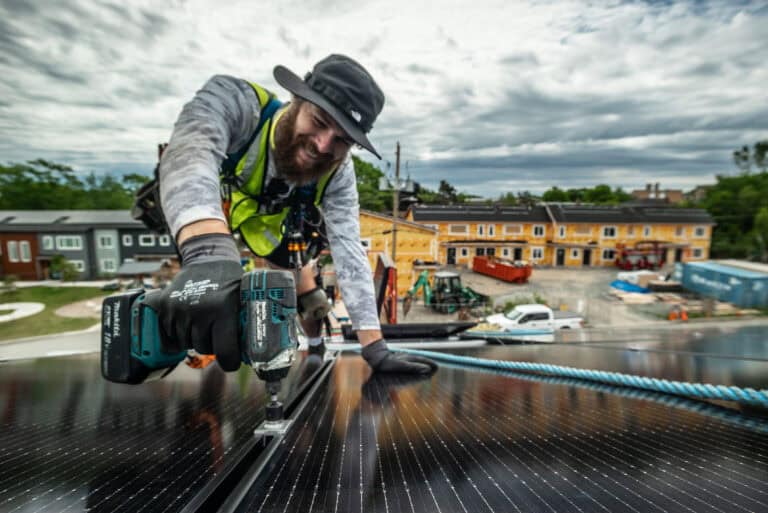
Mounting and racking (~10–15%) The hardware that attaches your panels to the roof. Quality matters here — Nova Scotia weather is not gentle. We don’t cut corners on racking.
Electrical work and wiring (~15–20%) Panel upgrades, conduit runs, disconnect switches, metering equipment. This is where a lot of variability in quotes comes from. Older homes sometimes need a service upgrade.
Permits and NS Power interconnection (~5%) Building permits, electrical inspection, and the NS Power net metering application. All included in our quotes.
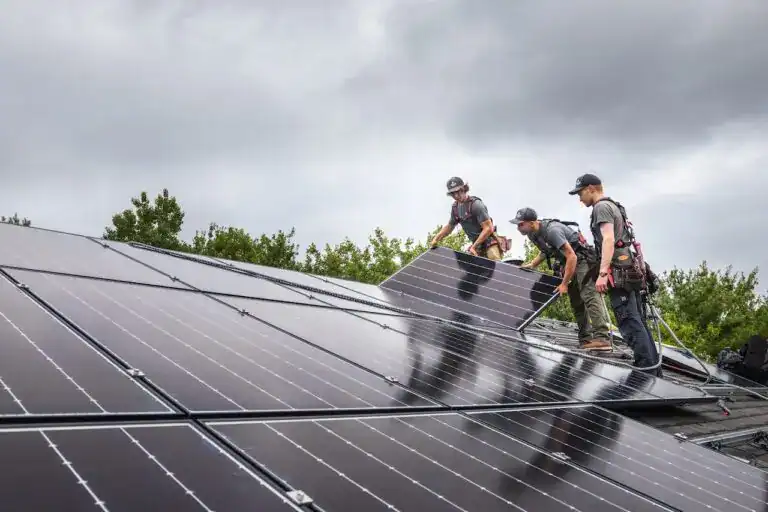
Labour (~20–25%) Design, project management, installation crew, and commissioning. With an in-house team, this is where we’re most efficient.
What Drives the Price Up (or Down)
Roof complexity is the biggest variable. A simple south-facing gable roof is straightforward. Multiple pitches, valleys, dormers, or low-slope sections add labour time and may require different mounting hardware.
Roof condition matters too. If your roof is within 5 years of needing replacement, it’s worth doing that first — removing and reinstalling a solar system later adds cost. We’ll flag this during your assessment.
System size affects per-watt pricing. Larger systems cost less per watt to install because fixed costs (mobilization, permits, interconnection) are spread across more panels.
Equipment tier affects upfront cost and long-term performance. Premium panels and inverters cost more but typically carry better warranties and degrade more slowly over a 25-year system life.
Service panel upgrades — older homes with 100-amp service may need an upgrade to 200-amp before solar can be interconnected. This adds $4,000–$6,000 depending on your setup.
What Does It Actually Return?
This is the question that matters more than the upfront price.
NS Power’s current residential rate is 19.128¢/kWh (as of May 1, 2026 — up 3.1% from the previous rate). Every kWh your solar system produces is a kWh you don’t buy from NS Power at that rate.
For a 12.5 kW system on a typical Nova Scotia roof:
- Projected annual production: ~13,000–14,000 kWh
- Net metering credit rate: 19.128¢/kWh (full retail rate)
- Estimated annual value: ~$2,500–$2,700/year
- Estimated cost: ~$29,500
- Estimated simple payback: 11–12 years
- System lifespan: 25–30 years
That means roughly 13–18 years of pure savings after payback — at today’s rates. If NS Power rates continue rising (they’ve increased every year since 2021), the payback period shortens and the lifetime return grows.
Does Solar Make Sense for Every Home?
No — and we’ll tell you if it doesn’t.
The homes where solar works best in Nova Scotia:
- High electricity use — bills over $150/month get the strongest returns
- Minimal shading — from trees, chimneys, or neighbouring buildings
- Roof in good condition — at least 10 years of life remaining
If your roof is heavily shaded, or your bills are consistently under $100/month, solar may still work — but the math is tighter. A proper assessment will tell you exactly what to expect.
Quick Reference
| Solar Ascent | Industry Average (NS) | |
|---|---|---|
| Price per watt | $2.20–$2.50/W | $2.60–$3.27/W |
| Typical 12.5 kW install | ~$29,500 | ~$32,500–$40,800 |
| NS Power rate (May 2026) | 19.128¢/kWh | — |
| Net metering credit | Full retail rate | — |
| Typical payback (12.5 kW) | 11–12 years | 13–16 years |
Pricing ranges are estimates based on typical residential roof-mounted installs. Final pricing depends on system size, roof complexity, equipment selection, and site-specific factors. Information current as of June 2026.
Solar Ascent designs and installs residential and commercial solar systems across Nova Scotia. Our team handles everything in-house — from design and permits to installation and NS Power interconnection. Get in touch here.
Frequently Asked Questions
Yes, solar is worth it for many Nova Scotia homeowners. Despite having shorter winter days, Nova Scotia receives enough annual sunlight to make solar energy a practical long-term investment. Through net metering, homeowners can earn credits for excess electricity generated during sunny months.
Solar can help reduce electricity costs, protect against future utility rate increases, and increase energy independence.
Most solar panels installed in Canada are designed to last 25 to 30 years or longer. High-quality panels gradually lose efficiency over time, but they continue producing electricity well beyond their warranty period.
Most grid-connected solar systems automatically shut down during a power outage for safety reasons. This prevents electricity from flowing back into the grid while utility crews are performing repairs.
Solar panels are designed to withstand Canadian winters and are tested to handle significant snow loads and harsh weather conditions.
While snow may temporarily reduce energy production, panels are typically installed at an angle that allows snow to slide off more easily.